
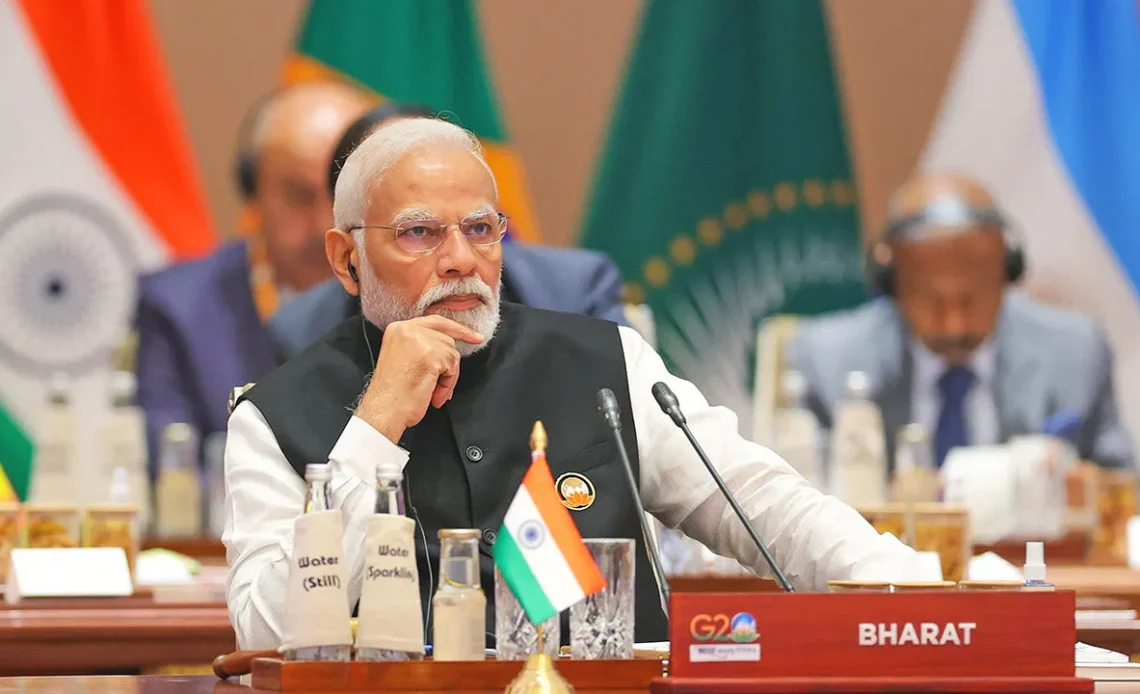
India posted 7.8% GDP growth in the third quarter of fiscal 2025-26 and is projected to report 7.6% growth for the full year. These numbers are well beyond the analyst’s estimates and position India as the fastest-growing major economy. Additionally, the inflation and unemployment rates – at 3.21% and 4.9% – being at modest levels, present India in a healthy economic state.
But, what if I tell you the numbers based on which you are making these judgements are incorrect. Well, that’s exactly what several economic bodies and economists have been saying. In this Blog, I will elaborate on the doubts raised over India’s economic numbers and how big a concern this is.
What did IMF say?
IMF which described India’s growth “robust” in the report, in the Appendix VII of the same report gave a ‘C’ grade to India’s national account statistics (GDP estimation process). This indicate that data presented and used by India suffers from deficiencies: use of outdated base year (2011-12), outdated Consumer Price Index (CPI) basket, using Wholesale Price Index (WPI) instead of more comprehensive Producer Price Index, serious gaps between production and consumption side estimates, using single rather than double deflation. inadequate coverage of the informal sector, and delays in publishing central and state fiscal data.
I will explain the jargons in a while, but in simple words, the data that is used by India to calculate its GDP numbers are flawed at its core, and hence, the numbers being projected in the last few years have to be taken by a pinch of salt.
Breaking Down the Jargons
Firstly, India’s manufacturing sector is divided in two types – the organized and unorganized sector. While the organised sector comprising of formally registered businesses give official data of their performance, the same is not possible for the unorganized sector. So, to calculate the performance, India uses a method of “faux proxies”, basically estimating it based on the performance of organised corporate sector only.
Former Chief Economic Advisor of India, Dr Arvind Subramanyan says this wasn’t a faulty thing to do till 2015 as the growth in both organised and unorganized sector was roughly the same. But that has not been the case since the three big shocks – demonetization, GST and Covid rocked the economy. Following this, there is no proper estimate on the actual estimate of the informal sector, but several independent and scattered estimates believe that it’s only in decline, while government numbers keep framing it as 5-6% growth.
Secondly, the calculation of nominal and real GDP. After adding the output of agriculture, manufacturing and services sector, we get the nominal GDP and after deducting the inflation, we need the ‘real’ GDP numbers, which is the actual metric we use. So, the concern is that India is undercalculating its inflation, which is making its GDP numbers look higher than what it actually is.
India has been using WPI as the deflator, which only covers certain areas of the economy and excludes the services sector. WPI also doesn’t include the inflation of input costs, which means India is only deducting the inflation of final goods and not the input costs used in making the product. So, we are understating inflation and as a result, overstating real GDP.
Additionally, there have been no official, timely consolidated data for the general government (central + state + local governments) has been published for as long as the 2015-16 fiscal year. This means it is impossible to accurately assess India’s true fiscal deficit and public debt.
Huge difference also exists between the income generated in the economy and expenditure growth, which is unusual according to economic principle. For example, if we take the latest 8% growth in the first half of 2025-26, which is the estimated income growth. So, the expenditure growth should also be around the same, but it’s just 5%.
One ‘Sham’ After Another
According to economist and professor Arun Kumar, the story started in 2015, when the GDP numbers (of 2011-12) were released but major lapses were flagged by the economists. Following this, a committee was set up to estimate the growth rate of subsequent years. But, when their estimate said that the GDP growth was higher in the UPA years than the NDA years, the government did not accept that (as if it was a marriage proposal). A new committee was setup by Niti Aayog – which is not the designated body for the job – and somehow it came with the favorable numbers estimating the NDA numbers above those of UPA.
In another shocker, the government refused to accept the consumer survey of 2017-18 (showing high inflation) and the unemployment data in 2018-19 (which showed highest unemployment in 45 years). Also, reports from 2017 indicated that around 35,000 companies were found to be shell companies around that period, however, the number reported in the services sector was kept unchanged. If all this wasn’t enough, India not holding census in 2021 (even till now) only worsened the cause as the numbers and policies kept being framed on obsolete numbers.
Other Points of Concern
Other than the regular figures posted by the government, there are a couple of indicators that give an idea of which direction the country is moving. The most important indicator is foreign investment. Just this January, foreign investors pulled out Rs 1.6 lakh crore from the Indian economy. Notably, the foreign investors don’t have any loyalty or ideology and operate simply on profit motive. So, such huge numbers being pulled out of Indian economy despite it posting such healthy numbers, shows there is something investors are sceptic about the Indian economy.
“Corporate investment as a share of GDP has fallen to 14 per cent, from a high of 19 per cent in the first half of 2016. Only at the height of COVID was corporate investment marginally lower at 13.7 per cent. Again, the question arises: why, if growth is so blazingly high, are Indian investors almost as pessimistic today as in the middle of COVID?” economist Ashoka Mody said in a report published in Frontline.
The crisis in the job markets is also startling. While the official government numbers only put it at 4.9%, it is again a huge underestimation. According to Indian Labour Organization, anyone who works even 1 hour for the whole day is counted as ’employed’ in some form or the other. So, basically this definition excludes all gig workers or contractual labours who are working there only because they haven’t got a proper job. How dire the situation is can be comprehended by looking at lakhs of students applying for a few thousand vacancies of average government job positions.
In Nov 2025, 1.2 crore people applied for less than 9000 positions in Railways. In Sep 2025, 25 lakh people, with many holding PhD, applied for 53,000 peon positions in Jaipur. In Sambalpur, 8000 candidates applied for 187 Home Guard positions, when they had to sit on an airstrip to write the exam as the number of applicants was beyond the government’s estimate.
The Way Forward
Economist Kumar estimates that if all these discrepancies described above exists, India’s GDP growth would stand at somewhere close to 2-2.5% instead of the 8% projected by the government. “The first point is the reliability of data. If the data is not reliable, then claiming we are the fastest-growing economy with an 8.2 per cent growth rate doesn’t sound very credible,” he said.
Prof. Pronab Sen believes the concerns raised by IMF as perfectly valid and says that India has delayed the changing of its base year for “far too long”. Prof Sen believes that even if we try it’s very hard to get over the discrepancies in our data simply because of the huge chunk of informal sector. He, however, stresses on the need of having more surveys in the informal sector.
Long story short, the government can keep boasting of high GDP numbers even as real wages decline, inflation and unemployment rise, foreign investment erodes. There is no way to fix the issue till there is an acknowledgement. The points stated in this article only highlight that something is very wrong with India’s economic numbers and there is an urgent need to go beyond partisan bias and clean the calculation. The “fastest growing” and “$4 trillion” tags hold no water till we keep ignoring the more granular economic metrics. As they say, devil lies in the details.
Lately, India has implemented a couple of changes; replacing base year with 2023-24 from 2011-12, making the consumer basket more comprehensive with 2024 base and more weight to non-food items, shifting to digital data collection. With census scheduled to held in 2027, the quality of data gathering should improve. I hope the government builds on this and comes up with more reliable and accurate numbers for the economy, without which no policymaking can be effective.
Thank You For Your Attention To This Matter