
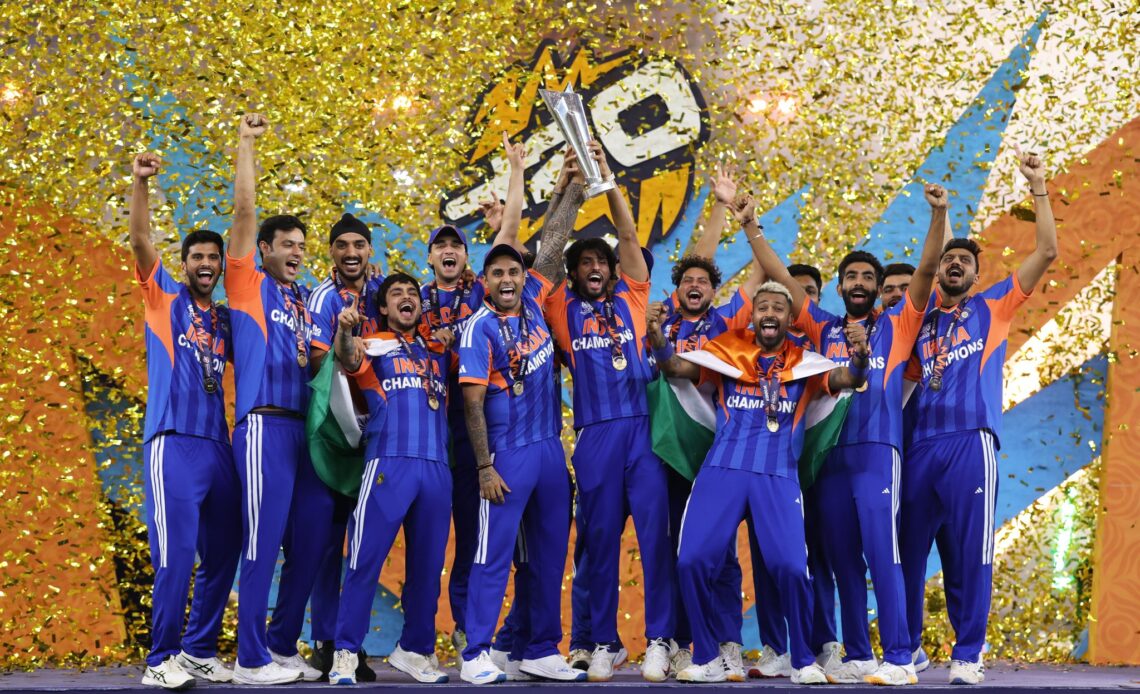
First time it was so nice, we had to do it twice. And just like that, India created history on Sunday, becoming the first team to defend T20 World Cup and win the title at home. With three ICC trophies within a span of 24 months, and the sheer dominance with which India has decimated the opposition in this tournament, it has emerged as the undisputed powerhouse of white-ball cricket, especially T20Is.
A major highlight of this victory was that unlike the past two wins (2024 T20WC and 2025 CT), this win was not 100% smooth and had its share of hiccups. A totally young team making its mark after the departure of legends like Virat and Rohit from the shortest format did a very fine job in repeating and defeating history.

Skipper Surya rescued India out of trouble with his valiant knock (Photo: BCCI)
Jittery Start Against USA
Hosts India had entered the tournament as absolute favorites owing to its UNBEATEN record in T20I series/championships since the T20 World Cup two years back. The group stage was not going to be that much of a challenge, as India was placed alongside Pakistan, Namibia, USA and Netherlands.
But, in a shocker, India’s start to the tournament was jittery. In its opening game against USA, the Indian batting came under strain as the USA bowlers, especially Shadley van Schalkwyk were unleashing fire. After in-form Abhishek got out the first ball, Kishan and Tilak too departed soon, followed by Hardik, Dube and Rinku, leaving India reeling at 77/6 in the 13th over. At one point, the biggest ‘upset’ of the tournament seemed imminent.
But, skipper Suryakumar – who was not in great touch lately, except the last series against New Zealand – held his nerves, spent time on crease before invoking himself in the last three overs. With the unique sweeps and slog hits, the 35-year-old took the charge and took India to a good enough 161/9.
Coming to bowl, India was on money from the start as Siraj and Arshdeep scalped three wickets in the powerplay putting USA on backfoot. Milind, Sanjay and Shubham tried to stabilize the innings, but the Indian bowlers were spot on with their plans and never allowed the run rate to tick up. Eventually, the co-hosts of the last tournament managed 132/8 at the end of 10 overs handing India a decent 29 run win.
In the next game against Namibia, India brought in Sanju for Abhishek, who had an illness. Invited to bat first, the Indian batters came out guns blazing. After Sanju departed for 22 off 8, Kishan kept pounding boundaries en route to his 61 (24). After middle-order faltered a bit, Hardik chipped in with his solid 52 (28) taking the team past 200. At one point, it seemed India might go near 230-240 mark, but Rinku Singh and tailenders just couldn’t get going in the last 2-3 overs, leaving India at 209/9.
The target was always going to be too much for Namibia and Indian bowlers made it further hard by executing their plans to perfection. Varun scalped three wickets, while Axar and Hardik got two as the African nation was bundled out at 116 in 18 overs.

Ishan Kishan played a scintillating knock against Pakistan (Photo: BCCI)
The Pakistan Game
India’s next game was the much-coveted clash against Pakistan. Due to the agreement reached during last year’s Champions Trophy (of both India and Pakistan playing only at neutral venues), Pakistan’s matches were kept at Colombo, Sri Lanka. And this time, their prospects actually looked promising considering the spin-friendly conditions there and the plethora of spin options it had; mystery spinner Usman Tariq, Nawaz, Abrar, Shadab, Saim Ayub and even skippier Salman Agha himself. Looking at all this, I was actually expecting Pakistan to do well, not just against India, but also in the tournament overall.
However, as the team clashed on Feb 15, the game was almost one-sided. Firstly, despite winning the toss, skipper Agha invited India to bat, which in my opinion was a disastrous decision, considering how poor his team’s batting form was to chase down a total against Indian bowling. The only success for Pakistan was Agha himself getting Abhishek’s wicket on the first ball. After that, they did try to build pressure with their spin, but Ishan Kishan, who was in a different league altogether, continued piling up runs with his high risk and attacking shots. He got out at 77 (40), but he had taken team to a comfortable position of 88/2 in the 8th over.
Tilak, Surya couldn’t pick up in terms of strike rate and Hardik too got out first ball on a poor shot, but late heroics by Shivam Dube (27 off 17) and a small cameo from Rinku (11 off 4) took India to a strong 175/7. It was quite clear that this total is going to be a mountain for Pakistan. Coming to bowl, India didn’t even give space for Pakistani batters to breathe. Hardik drew the first blood removing the dangerous Sahibzada Farhan in the very first over with a smart bouncer. Bumrah, in the next over, got the better of young Saim Ayub and captain Agha, leaving Pakistan 13/3 in 2 overs. The Men in Green just couldn’t recover from that point. Usman Khan tried some hits, but Indian bowlers kept executing their plans eventually bowling out Pakistan at 114, handing India a handsome 61-run win.
In its last league game at Ahmedabad, India chose to bat first. Its start wasn’t good again as Abhishek got out on hatrick of ducks followed by Kishan a while later. Tilak (31) and Surya (34) couldn’t capitalize on their starts. This time the mantle was taken by Shivam Dube, who scored a blistering 66 (31). A fiery cameo by Hardik (30 off 21) took India to a good enough 193/6. But, after a long time, Indian bowlers looked rusty – a trend which marred India’s chances for quite a while in the tournament. Wickets kept falling at regular intervals and no Dutch batter was able to present a threat, but still they managed to put up a decent 176/7 at the end of 20 overs, as India won the game only by 17 runs.

South Africa continued its red-hot form to annihilate India in this defeat at Ahmedabad (Photo: ICC)
South Africa Demolishes India
It was very clear, at least to me, that the main tournament will only start in the Super 8 stage. The pre-seeding system (which I don’t like) meant India got a very competitive group with South Africa, West Indies and Zimbabwe (was supposed to be Australia, but they were knocked out). Up again in the Narendra Modi Stadium, Proteas decided to bat first, in what was a smart call.
Indian bowlers started off very well knocking Markram, de Kock and Rickelton reducing South Africa 20/3 in 4 overs. But, from this point, India allowed the game to slip as much as it shouldn’t have. Brewis’ 45 (29) and Miller’s 63 (35) took the team in a formidable position and Stubbs’ quickfire finishing (44 off 24) smashing 20 runs in Pandya’s last over, propelled them to a solid 188, which was above par on that wicket. India had made a strange call of playing Sundar in place of Axar, but the plan clearly didn’t work as he bowled only 2 overs.
Coming to bat, India was under pressure and the Proteas capitalized on that. After skipper Markram removed Kishan on duck, followed by Tilak (1) and Abhishek (15). Sundar was sent up the order, but nothing worked for India that day, as they were soon 51/5 and then 88/8. Pandya and Dube tried to take the game deep, but the asking rate kept mounting leading to further fall of wickets. Dube top-scored at 42 (35) as India was wrapped up at 111, handing Proteas a mammoth 76 runs win.
The magnitude of this win meant India’s net run rate (NRR) plummeted to abysmal level. After West Indies defeated Zimbabwe with an even bigger margin, the prospects for the Men in Blue went even grimmer. Now, it needed Proteas to defeat Windies at all costs, as otherwise if both India and WI ended at 2 wins, the difference of NRR was so huge that India couldn’t have make it to the semis. From being the favourites just 2 weeks ago, to now staring at the prospect of elimination, the Indian dugout was under severe strain and criticism. It needed to do something new.

Hardik Pandya propelled the team with his contributions on all 3 aspects (Photo: BCCI)
Redemption Against Zimbabwe
Now, no one was expecting Zimbabwe to win, but the way the African country had fared in the tournament defeating mighty Australia and co-hosts Sri Lanka, they were expected to put up a strong competition.
Here, the dangerous looking Indian openers hadn’t clicked so far, and both lefties also prompted the opposition skipper to bring the off spinner early on. So, India decided to make an unexpected change. Sanju Samson, who seemed a permanent opener for India till 2 years back before his form faltered just mildly after which he was replaced first by Gill (who faltered even worse) and then by in-form Ishan Kishan, was now asked to take on the opening slot once again. This meant Kishan went at 3, Tilak at 5/6 and Rinku unfortunately missed out. Now, this arrangement asked for many batters to play out of their comfort zones, but the unit was ready for it.
The experiment worked as Zimbabwe didn’t bring in off spinner early on and India went off a flyer. Though Samson got out on 24, Abhishek – who was out of touch so far – scored a brisk 55 (30) taking India past 120 mark in 10 overs. He was followed by some destructive cameos from Kishan 38 (24), Surya 33(13), Tilak 44 (16) and Hardik’s 50 (23) taking India to a huge 256/4.
The total was definitely beyond Zimbabwe’s reach, and they also didn’t go for it in whisker and instead progressed the innings steadily. Brian Bennett – the young man who had a great tournament – held one end till the very end, scoring 97 off 59. Indian bowlers couldn’t create much of a magic on this flat wicket and Dube conceding 46 runs in 2 overs meant Zimbabwe ended at 184/6 in 20 overs handing India a 72-run win (margin ideally should’ve been bigger). But, with this win, India was back in the hunt.
Also, Proteas defeating West Indies comprehensively meant that the India-West Indies game at Eden Gardens. was the virtual quarter final for both teams.

Sanju Samson unleashed his A game playing his career best knock in Kolkata (Photo: BCCI)
Sanju Samson Show in Kolkata
West Indies entered this game with solid form (losing only 1 game) and a dangerous record (never losing at Eden Gardens). India won the toss and decided to bowl first, in a wise move. West Indies started off well but were not off a flyer as such. Varun removed struggling skipper Shai Hope at 32 (33). Bumrah gave double blow removing dangerous Hetmyer 27 (12) and Chase 40 (25) reducing them to 103/3 in 12 overs. From here, Holder 37 (22) and Rovman Powell 34 (19) took the mantle to take the team to a strong total. Despite all hiccups, India managed to restrict them at 195/4, which was still a challenging total.
In batting, Sanju Samson took the charge of leading the chase. As Abhishek and Kishan – both at the score of 10 – departed early, Samson kept the chase on with his sustained aggression. A huge highlight of his knock was instead of relying only on big slog hits, the 31-year-old was playing across the field, timing the shots very well and was rotating strike judiciously. Despite Surya (18) and Hardik (17) not adding much and Tilak too falling after a brief cameo of 27 (15), India was in control of the game. India needed just 7 runs in the last over and as fate had it, Samson finished things off with a six and a four on the first two deliveries. His 97* off 50 balls was one of the GOAT knocks in T20I chases and his career-best for sure (even though he has 3 100s). India was in the semis.

Jasprit Bumrah choked England in the crunch death overs (Photo: BCCI)
India Escape a Nail-Biter Against England
England’s campaign so far was full of ups and downs. It lost to West Indies, almost lost to Nepal, and weren’t comprehensive even against Italy. But, they were back with a bang in the Super-8 defeating New Zealand, Pakistan and Sri Lanka. In the semi-final at iconic Wankhede stadium, England won the toss and invited India to bat first, which was understandable considering the record at the venue. But Indian batters had got the much-needed confidence and now there was no stopping them. Though, Abhishek’s struggle continued as he again got out at 9, but Samson led the charge with another stellar knock of 89 (42) missing out on another hundred. Kishan 39 (18) and Dube 43 (25) kept the tempo up while Hardik 27 (12) and Tilak 21(7) also chipped in their quick-fire cameos taking India to a mammoth 253/7 in 20 overs.
While, everyone was assured of an easy India win, there came a shocker as English batters started on overdrive mode right from the start. Despite India getting Salt (5) and Brook (7) early, England managed to get 68 in the powerplay. It was the rising star Jacob Bethell, who took the charge of the English chase, hitting sixes at ease and picking up pacers and spinners alike. Varun was particularly targeted as he conceded 64 runs in his 4 overs. At 172/4 in the 14th over, it was anyone’s game, but Indian bowlers held their nerves on the wicket.
They were further helped by the Indian fielding – which rose up on the perfect occasion, after being under radar for last few months. Arshdeep got dangerous Jacks and Hardik removed Curran – both in what were magnificent catches. Then came Bumrah conceding just 15 off his last 2 overs which meant England needed 30 in the last over with Bethell still at the helm. But, he fell on the very first ball trying to steal a double after playing down the wicket, owing to a great throw and glove work by Hardik and Samson respectively. That was effectively the end of England’s hopes. Archer did hit last 3 balls for six, but the target was beyond them as India pulled off a thrilling 7-run victory right in front of former captain MS Dhoni, who was in attendance (Thala for a reason).
On the other hand, New Zealand, which also had quite a middling tournament so far – having lost to South Africa in the group stage and then to England in the Super-8 – were again up against Proteas, the only UNBEATEN side in the tournament so far. But, springing a massive surprise, the Blackcaps unleashed their A-game. Firstly, they restricted South Africa to under-par 169 and then put up a scintillating Allen-Seifert show with the bat. Finn Allen produced an absolute masterclass en route to his 33-ball 100, and along with Seifert (58 off 33) took his team home in just the 13th over. How both the teams had fared so far, this result was absolutely unprecedented.

Abhishek Sharma, who struggled entire tournament, came up with his best in the finals (Photo: BCCI)
India Break Ahmedabad ‘Jinx’ To Lift Trophy
With things under control and team peaking at the right time, hosts India were the favourites coming into the final. The only thing that stood between the Men in Blue and the trophy was the Narendra Modi Stadium, and the jinx around it, considering the heartbreaking result of last final it played there. This time again the rival skipper (Santner this time) won the toss and decided to bowl first. In my opinion, Blackcaps lost a key advantage right there.
Coming to bat, Indian batters started right from where they’d finished in the last game. Abhishek, who was not in his prime touch so far, produced a vintage knock of 52 (21) scoring the fastest 50 in T20WC history. He was followed by Kishan’s berserk 54 (25), all this while as Samson led the Indian innings once again with another iconic knock of 89 (46). Dube chipped in with another superb cameo (26 off 8) to take India past its third 250 total in the tournament. Had not for the 3-4 low-scoring overs in the middle, where New Zealand tried getting things under control, India could’ve gone past 300 too.
The total was always going to be too much for New Zealand, and they needed a quickfire start to even stay in the hunt. But, after Axar removed dangerous Allen in the fourth over followed by Bumrah getting Ravindra, Blackcaps kept plunging under pressure. Seifert (52) scored another fifty but got no support from the other end as Axar scalped Philipps, Mitchell and Hardik got Chapman, all while the asking rate kept mounting. Skipper Santer (43) played some good shots, but Bumrah finished things off with this missile-graded yorkers, wrapping up the New Zealand innings at 159, handing India the biggest ever win in a T20 World Cup by 96 runs.

Historic Win
India’s campaign was a prime example of how a smooth transition takes place; a young team emerges from the shadows of former star players, adopts a new aggressive approach and wins the trophy with such a stamp of authority. It should be noted that India is yet to lose a series/trophy/championship under Surya’s captaincy. It was not just 1or 2 players leading, but everyone hunting in pack. Samson, Ishan, Hardik, Bumrah with his masterclass, the cameos from Dube and Axar, everyone was on song. The best part is in addition to the XI that played in the tournament, even those sitting outside or those who missed out are full of class and talent, which just shows how strong India’s cricketing ecosystem is today.
This campaign was also a big litmus test for Gautam Gambhir, who has been receiving a lot of flak for the team’s poor outing in Tests and middling performance in ODIs. But, when it comes to T20Is, there was hardly any doubt that Gambhir – who is yet to lose any final as player or coach – will be able to guide this young team through. After this win, the next challenge is definitely the 2027 World Cup in South Africa. But, the T20I team will also have its eyes on the 2028 Olympics Gold, which will mark the grand return of this game on world’s premier sporting event. There is high probability that GG’s tenure (at least in white-ball) might be extended well beyond 2027 World Cup.

Concerns and Road Ahead
Now, I would’ve liked ending the blog on a positive note, but there is a big underlying concern that I can’t ignore talking about. The fall of India in the longest format. In its last 19 games, India has won just 7 and lost 10. The biggest shocker was the two whitewashes against South Africa and New Zealand at home. The series draw in England was good but came on flat wickets against an average Bazball team. India is yet to win a home test against a big team under Gambhir. All these horrible numbers point to the clear fact that something is wrong.
Now, I don’t think the change of guard should be made at this point as it might affect the morale of the white-ball setup. According to me, instead of preferring white-ball performers, we need to opt for Test specialists in the team. I want to see Abhimanyu Easwaran, Auqib Nabi Dar and Sarfaraz Khan in whites when India plays its next test match. Also, the idea of holding camps 15 days prior to any test series under guidance of specialists like VVS Laxman – who is also head of BCCI Centre of Excellence – is a very good and should be brought in. Though, I don’t see India making to the finals of this World Test Championship (WTC) cycle as well, but Gill and team should keep their focus on building the squad with long-term focus and
Anyways, I would like to end this blog by again highlighting the fact that India is a genuine superpower in world cricket, especially in the white ball. So, let’s hype and celebrate this win as much as possible.
“We’ve counted enough milestones, now it’s time to count trophies”: Coach Gautam Gambhir