
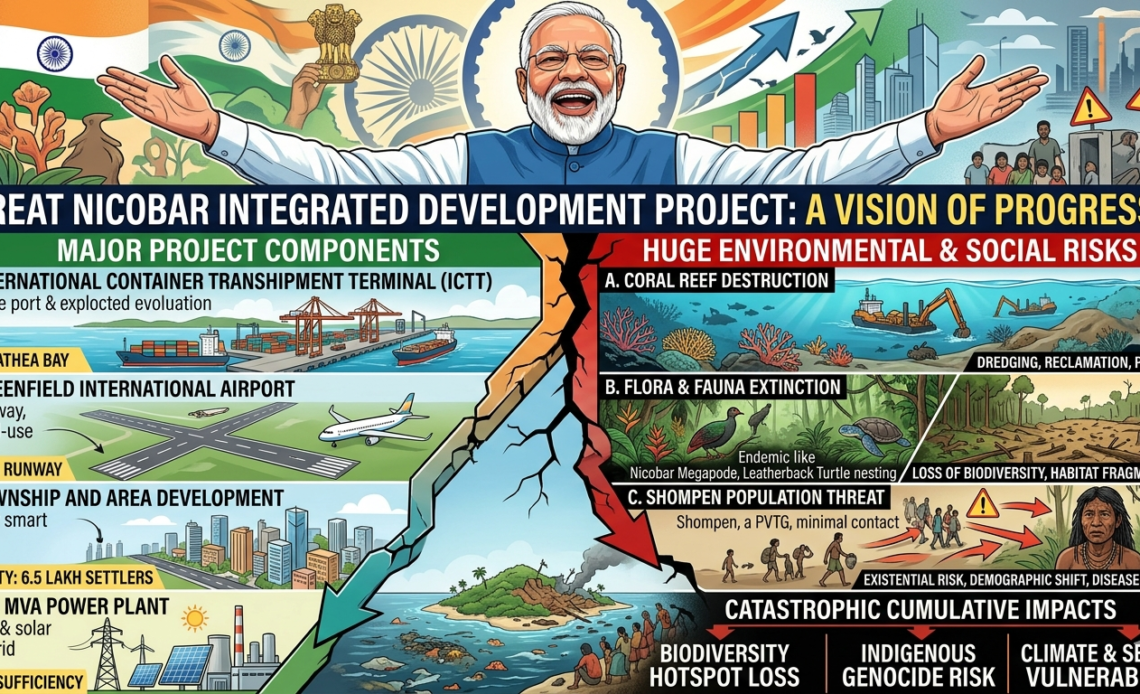
Amid a tense election season in the country, a rather unique but important issue has popped up, the Great Nicobar Project. Hailed by government and its supporters as the next ‘masterstroke’, while considered extremely dangerous and catastrophic for ecology by environmental experts and opposition. In this Blog, I will try to look at all the major aspects of the project, including the less talked about ones, and then give my verdict on it.
What is the Great Nicobar Project?
The Great Nicobar Project is a massive ₹72,000-₹81,000 crore plan, that envisages to transform the southernmost island of the Andaman and Nicobar archipelago into a global trans-shipment hub. The project includes developing a major international container terminal to compete with regional hubs; a dual-use international airport for both civil and military use; a 450 Megavolt-Amperes (MVA) gas and solar-based power plant and a grand 160 sq km township having hotels, apartments, casinos, gaming and entertainment hubs. The plan is also to increase the population in the whole enclave (under project) to over 6.5 lakh by 2050 from 8,500 currently.
‘Strategic Rationale’ behind the project
According to the government and its policy advocates, the project aims to leverage the location near the Malacca Strait and position India as a maritime hub for gateway and trans-shipment cargo, reducing the dependence on foreign ports like Colombo, Singapore and Hong Kong. India pays around $200–220 million annually in trans-shipment costs to through third-country ports, which can be overcome by the project.
The other major strategic motive, as per the government, is to position the location as India’s ‘Eye of the Indo-Pacific’. Developing dual-use port and airstrip will allow India’s air force and navy to deploy some of their key aircrafts, submarines and destroyers close to the Malacca Strait. This can help India both in monitoring the naval movements around the region (particularly of China’s), and also in establishing a deterrent force in the Malacca region considered crucial to Beijing’s energy imports.

A rough diagram explaining the project design (Photo: The India Forum)
Environmental Concerns with the Project
Now, while the government continues to paint the Great Nicobar Project as a strategic masterstroke in making, there are some serious environmental, ecological and humanitarian risks involved with it. Firstly, the project will oversee the felling of 9.64 lakh trees according to government figures, with independent estimates claiming over 50 lakh trees. Now, the government has come up with the ‘assurance’ that it will compensate for the loss by planting trees in over 240 sq km land in Haryana.
Now, if you think it sounds odd, that’s because it actually does. How can trees in Haryana’s arid landscape compensate for the ancient biodiversity of a rare tropical rainforest? The safari park planned in Haryana’s Aravalli Hills has already been flagged for the environmental risks of its own. Even if we keep that aside for a minute, there is no guarantee of any compensatory afforestation of saplings actually resulting in large trees. A recent report found how nearly half the trees transplanted for the Central Vista Project in the national capital, have already died.
Another concern is the loss of rare flora and fauna, that the island will endure under this project. According to a report published in Frontline, its flora encompasses over 650 species of angiosperms, ferns, gymnosperms, bryophytes, and lichens. Its fauna also numbers over 1800 with new species being discovered every year. The 202 km coastline is borders rare coral reefs harboring around 180 coral species. Additionally, the island provides critical feeding and nesting grounds for 87 per cent of all the turtles in the region.
Even bigger catastrophe will be meted on the indigenous Shompen population, found nowhere else. Considered a Particularly Vulnerable Tribal Group (PVTG), their total number stand somewhere between 200-300 (229 according to the last Census). This project effectively calls for totally annihilating the living space, the culture and future of these people. How can this blatant environmental and humanitarian violation be justified on any grounds? In 2024, genocide experts from 13 countries warned that the Great Nicobar Project would be “a death sentence” for the Shompen people.
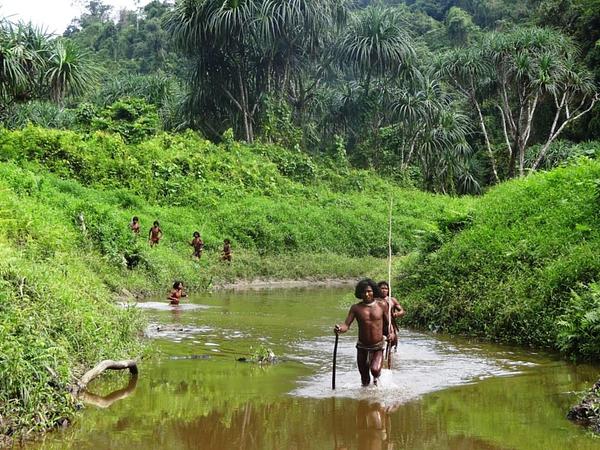
Shompen population are on verge of extinction facing massive risks with the project (Photo: Survival International)
Geological and Seismic Risks
If you thought, the concerns with the project are only environmental, you’re wrong. Even bigger is the geological risk associated with the region. Great Nicobar lies in one of the world’s most tectonically active zones. The 2004 earthquake – 9.2 magnitude which killed over 2.8 lakh people – led to permanent coseismic subsidence (whole island tilted like a seesaw) of the whole island by 15 feet and also drifted southwest by 5 feet.
Now, what sense does it make to make such heavy projects and multifold population increase in such a geologically sensitive region. Who will be responsible for any mishappening in future? We are already seeing the result of Char Dham road-widening project – secured by ignoring expert objections and citing national security – in the form of regular landslides and destruction of its fragile mountain ecosystem. This is precisely the reason, people of Ladakh are so paranoid about the prospect of uncontrolled mining and infrastructure projects on their land.
The Nicobar Island is home to vast amount of flora and fauna, all at brink of end (Photo: Frontline)
‘Flawed’ methodology for clearance
As it must be known, the National Green Tribunal (NGT) has already cleared the project in February. Citing its “strategic importance”, the body gave green signal and said there was “no good ground to interfere” as “adequate safeguards” are in place. Now, why this is problematic is the NGT seems to have taken everything the government said on face value and totally ignored all the grave concerns raised by experts. From the government’s point of view, it has become very easy to get any project with environmental concerns get cleared just by citing ‘national security’ and ‘strategic importance’.
However, even these clearances are not that clean, as there have been several allegations regarding using methodologically flawed and manipulated tests. For example, the assessment of sea turtle nesting sites was conducted in the off-season for nesting, so that the result shows limited impact on turtles. An investigation by Scroll alleges that the government very cunningly manipulated the official maps of the Great Nicobar island to move coral reefs from coast to deeper waters – a feat deemed impossible by scientists – to somehow downplay the project’s impact on the reefs.
Where things stand today?
Well, today the project looks totally on track towards implementation. Even though, Congress party is staunchly opposing the project, there is not much it can do to stop the implementation. Even if it somehow comes to power in 2029, much of the damage to the island’s ecology would already been done. The government will keep the words of ‘national security’ and ‘strategic importance’. But at what cost? So much disregard for the natural habitat on the island, and the Shompen population, who are living on this land for thousands of years and are on verge of extinction. Is the damage after the projects in Uttarakhand not enough to learn the lesson? It is the responsibility of everyone to raise voice against the blatant violation of environmental and humanitarian norms and become the voice of the voiceless.
JAI HIND