
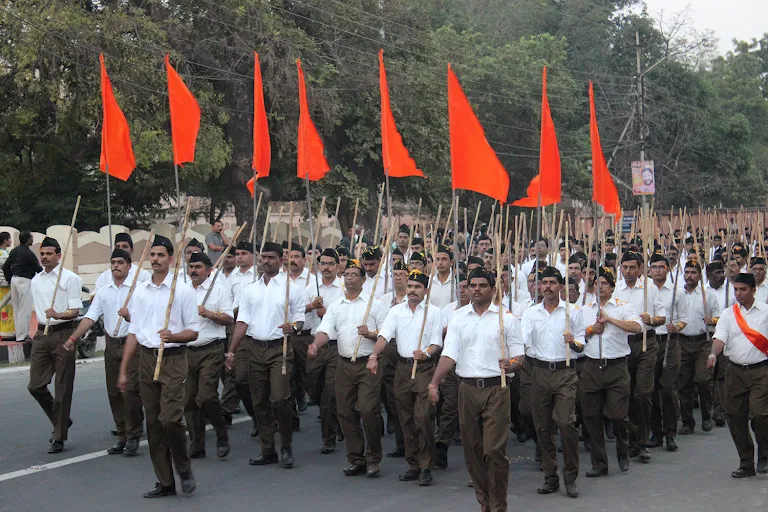
A far-right organization starts with 5 people and expands over 4 million members in over 80,000 branches (shakhas) across the country in last 100 years. From being a fringe group for majority part of its existence, it rose to a level where it influences India’s government formation and decision making. It runs schools, holds cultural-religious programs, carries out training camps, receives donations (small to huge) and has recently built a seven-storied lavish office in the national capital. But what if I tell you that the group I am talking about is not even legally registered as anything…sounds strange, right?
This is the story of Rashtriya Swayamsevak Sangh, the RSS, and its strongly divisive yet extremely influential ideology that now rules the country, which I will discuss in detail in this blog.
The Emergence
Keshav Baliram Hedgewar, one of the founding fathers of the Hindutva ideology, founded the RSS in Nagpur in 1925. This was a time of lot of churns in India’s independence movement. Especially, after the Khilafat Movement – which Mahatma Gandhi tried for uniting Hindus and Muslims against British – failed, it led to a series of communal riots in India. Amid this, Hedgewar founded the RSS in Nagpur, with the aim to “unite Hindus” who according to him were “weak and divided”.
The core of this ideology was derived from Vinayak Damodar Savarkar’s 1923 writing ‘Hindutva: Who is a Hindu?’ The definition presented by Savarkar and taken forward by the RSS defined a true Indian as someone who considers this country as both their fatherland and holy land. This whole definition was precisely designed to present Hindus as superior race, and the Muslims and Christians as someone who don’t belong here naturally. According to Madhav Sadashiv Golwalkar, another key founding leaders of RSS, all non-Hindus should remain in India “wholly subordinated to the Hindu nation, claiming nothing, deserving no privileges, far less any preferential treatment—not even citizen’s rights.”
If the word ‘fatherland’ didn’t sound an alarm in your ears, let me ring it for you. The RSS ideologues were heavily inspired by Hitler’s Nazi ideology for its ‘race pride’ and ‘nation building’. Golwalkar himself strongly praised the persecution of Jews and said it serves “a good lesson for us…to learn and profit by.” Interestingly, the RSS was also very much inspired by the Zionist ideology (which called for establishing a Jewish state). Golwalkar praised the Jews for keeping their race, religion and culture alive despite years of persecution. Savarkar was one of the strongest supporters from India, of the formation of a Jewish state. This Hindutva’ support for Israel (Jewish state) comes from a shared hatred for Muslims and the manifestation of a hard religion-based state where minorities are ‘kept in check’. Well, being inspired by both Nazis and Jews…just RSS things.

The first ideologues of RSS who spewed the idea of ‘Hindi-Hindu-Hindustan’ (Photo: Wikipedia)
Role in Independence
The biggest and most popular criticism of the whole RSS movement has been their conscious and cunning absence from India’s freedom movement. Even though RSS was formed in the peak of the freedom movement, it refused to participate in the struggle calling the fight for freedom “superficial” while pressing for the need to unite and strengthen the Hindu society. Even during the most impactful episodes like Mahatma Gandhi’s Salt March (1930) and the Quit India Movement (1942), RSS categorically instructed its members not to take part in any anti-British movements.
It rejected the tricolor flag as India’s national flag calling it a “compromise” and “psychological injury” to the country. Its mouthpiece, the Organiser stated that the tricolor would “never be respected and owned by Hindus”. It was not until 2002, that tricolor was hoisted at RSS’ headquarters. Now, while they pretend that the Flag Code of India didn’t allow private individuals and bodies from hoisting national flag till then, it is also true that several institutions did hoist it, especially during Independence Day and Republic Day, so it’s a lame excuse. In another shocking episode, when the Indian National Congress passed a resolution for ‘Purna Swaraj’ and decided to celebrate January 26, 1930, as ‘Independence Day’ by hoisting the national flag, even then RSS decided to hoist its saffron flag.
Similar was RSS’ contempt against India’s national anthem and even more so, against the Constitution. An Organiser editorial explicitly criticized the Constitution for making no mention of ‘Manusmriti’ (religious book which considers women and Dalits as second-class citizens) which it called the “true way of life”. The RSS viewed the ‘secular’ definition of the country as a “western concept” and wanted India to be clearly defined as a Hindu nation. It is also public knowledge that RSS was not very comfortable with Rabindranath Tagore’s ‘Jana Gana Mana’ as the national anthem for its pluralistic theme and even made false assertion that it was made to praise Britain’s King George V. It instead preferred Bankim Chandra Chatterjee’s ‘Vande Mataram’ for visualizing the country as a ‘Hindu goddess’.
Even after India’s independence, RSS didn’t change its style of functioning. Its role specifically came under scanner during Mr Gandhi’s murder by Nathuram Godse, a member of RSS. Several top leaders repeatedly highlighted RSS’ active role in spreading communal hatred and instigating bloody riots. India’s first Home Minister Vallabhbhai Patel (BJP’s favourite), while banning RSS said that many of its members were celebrating Mr Gandhi’s murder by distributing sweets. “All their speeches were full of communal poison… As a final result of the poison, the country had to suffer the sacrifice of the invaluable life of Gandhiji,” he said.
The internal intelligence agencies repeatedly reported about Hindus affiliated with the RSS carrying out vandalization and attacks, all while impersonating as Muslims for creating communal unrest. Pandit Jawaharlal Nehru, India’s first prime minister, wrote to officials multiple times about how RSS operates like a paramilitary organization. India’s first president, Rajendra Prasad – often celebrated by today’s right wing – himself wrote to Nehru Prasad warning about RSS and expressed deep worry about the organisation’s physical combat trainings, which he feared can bypass the country’s legal framework and be a threat to India’s communal harmony.
And now comes the bombshell! The Hindu Mahasabha, the outfit that later formed Jan Sangh and then BJP, made a coalition government with the Muslim League in Bengal, Sindh and the North-Western Frontier Province at the peak of freedom struggle and partition debate. Syama Prasad Mookerjee (the hero of Hindu right) was an active part of the alliance and served as the finance minister of undivided Bengal. Not just that, he even wrote a letter to Bengal’s Governor General ahead of the Quit India Movement 1942, calling for “preserving internal order”. Stating that “there was no need for Independence from British Rule” he expressed his willingness to offer his “whole-hearted co-operation” in curbing the movement.

The complex and opaque structure used by RSS and its affiliates to evade accountability (Photo: The Caravan)
The Cobweb Structure
Now, while the RSS has not registered itself as an organization and refers to itself just as a “group of individuals” it has many organizations under its umbrella, which perform the tasks of a registered unit. And I am not talking only about the extremist outfits like Vishwa Hindu Parishad (VHP) and Bajrang Dal. An explosive report by The Caravan, found out how over 2500 organizations globally have “concrete, traceable and material ties” to Sangh. While Sangh very cunningly tries to portray it as a loose coalition of like-minded organizations with a “shared commitment to Hindutva and nationalism”, this whole system of shared offices, officers and events are part of a meticulously planned system to evade all formalities and accountability.
For instance, the report highlighted 21 different organizations housed at Ved Mandir Complex, Jammu, all affiliated with the Sangh. Multiple organizations differ only in name, but have almost same mission, same people and at times even same location. That’s not where the game ends. Since Sangh is not registered, it doesn’t file any records of its source of income. While it maintains it doesn’t receive any foreign money and doesn’t have any major source of income other than “member contributions”, there are many organizations affiliated with Sangh who receive funds from overseas through FCRA (Foreign Contribution Regulation Act), and also through trusts and corporates domestically.
“The Sangh has never entertained the idea of building an organization as a distinct and separate unit within society. Right from its inception the Sangh has clearly marked out as its goal the moulding of the whole of society, and not merely any one part of it, into an organized entity,” Golwalkar said.
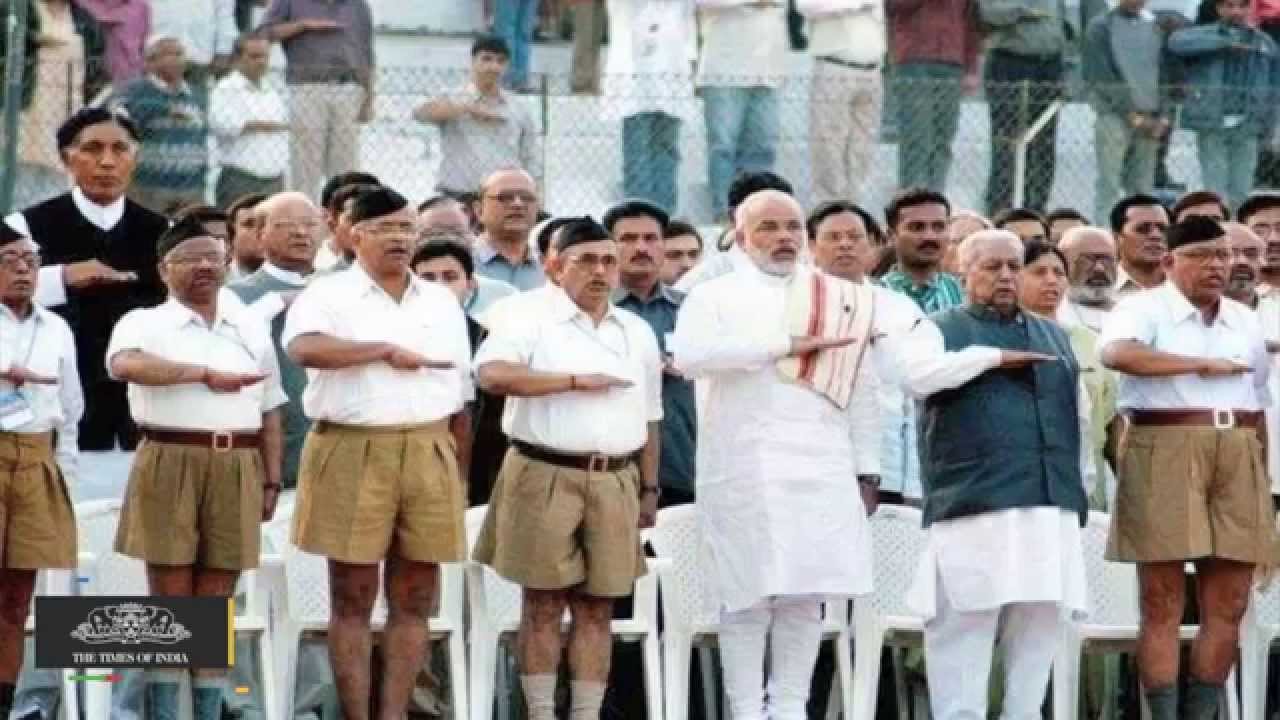
The current BJP-led government is the most SAFFRON government in India’s history (Photo: Times of India)
The Debate Over ‘Registration’
This debate ignited recently when Karnataka Home Minister Priyank Kharge wrote a letter to RSS chief Mohan Bhagwat demanding accountability over Sangh’s registration, funding sources and tax compliance. Stressing that an organization as influential as RSS should be registered as it seeks government security, he demanded the body to disclose its operational and financial details. However, the letter only invited weird responses. Mr Bhagwat said that even the ‘Hindu’ religion is not registered, so why should RSS? I mean what kind of a response is that? Also, the arguments of Sangh not taking money and holding “open meetings” don’t hold water legally, as we discussed above.
Around three-fourth of the whole BJP cabinet feature leaders affiliated with RSS, which includes the Prime Minister, Home Minister and the party chief. There have been multiple confirmed instances when senior BJP ministers have presented ‘reports’ of their performance to RSS and sought their ‘direction’. Now, leave aside the arguments of both sides and think from a rational mind. Should an organization of the scale of RSS, which yields such a massive influence over the working and decision making of today’s government, be allowed to continue with the current opaque structure.
Contrast this with the constant demand from the Hindu right-wing about registration of Muslim Madrassas and Christian missionaries. If the government can come up with bills – Waqf Act 2025 and FCRA Bill 2026 – to control the functioning and funding of religious bodies, then why demanding RSS to register and disclose its financial details sound so alien?
The RSS recently inaugurated a lavish deluxe headquarters in the national capital, called ‘Keshav Kunj’. The 13-storeyed building built at the cost of 150 crore spans over 5 lakh square feet. While the RSS claims it’s totally been built by public contribution, just imagine a random person disclosing no income coming up with such huge villas, will the government and Income Tax department not bat an eye? Mr Bhagwat even enjoys a Z+ security. Many other leaders and offices also get different levels of security. Is it not a valid question to ask by which authority the Home Ministry is spending tens of crores of taxpayer’s money on un-elected, un-registered and at times uneducated people and bodies. This is a question that should haunt any honest and educated taxpayer.
Hindutva’s Ascend to Power
Today, there is no doubt in saying, nor the government has in accepting, that today the country is being ruled by a Hindutva government. If you study the real ideology and vision of the Hindutva ideologues, you might start making better sense of today’s India. Afterall, what else can one expect from an organization whose anthem explicitly worships “Hindu Rashtra” and not the Indian republic. Whether it’s the targeted mob lynchings of Muslims, attacks on Christian festivals, saffronization of cinema and curriculum; there is one ideological force behind all of this. Now, while the Sangh might distance itself, but that’s precisely the point of keeping such a complex and opaque organization.
So, do I think RSS should be banned? Not at all. Every ideology has the right to exist in a healthy democracy. You can ban 1 or 2 groups but can’t stop an ideology. The RSS was already banned thrice, but that couldn’t stop it ascend to power. Also, RSS’ aim has been less about capturing the government than about capturing the society. What I am simply demanding here, like many others, is for the Sangh to be registered in whatever capacity looks sufficing and give a proper detail of its organizational and financial working. And I don’t think it’s that unreasonable to demand disclosure from a body maintaining opaque financing and yet availing government security.
THANK YOU FOR YOUR ATTENTION TO THIS MATTER