
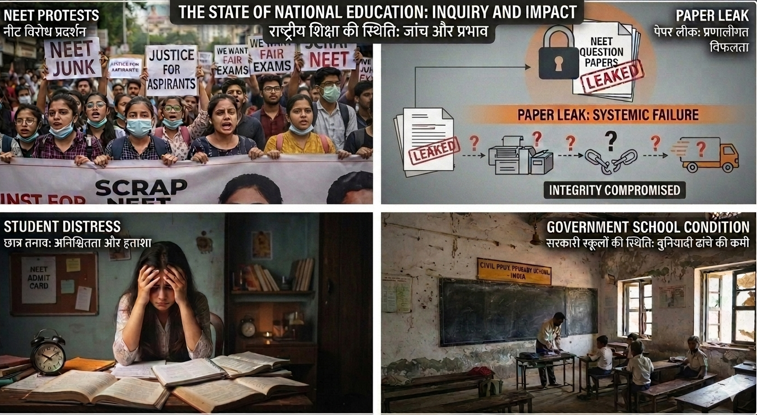
Education has to play a key role if a country has to progress, and more so, emerge a superpower in the new global order. Whether one wants to look at the example of Japan, China or the Nordic countries in Europe, it was always quality education at all levels, that led to a robust economy and society. However, when we look at India, the self-proclaimed Vishwaguru aiming for ‘Viksit Bharat’ by 2047, there is a very alarming picture.
Now, I am not just saying because of the recent episodes of NEET and NTA that have been headlines just recently, but it’s a whole long-standing issue about where the priority and accountability (if any) lies. In this Blog, I will try to examine this by presenting facts and instances from across the country.
Why the new changes in NCERT’s History Textbooks are ‘Problematic’ – Arunesh Blog
NEET Paper Leak
The National Eligibility cum Entrance Test (NEET) is the ONLY major exam in the country if one wishes to pursue a medical degree from a government institution. The fact that over 24 lakh students compete for around 90,000 seats every year, must give you an idea how brutally competitive the exam is and how ruthless preparation it demands. The 23 lakh+ students who don’t qualify are left with three broad options: study from private college paying total course fee of over 1 crore; study from a foreign country (like Ukraine, Kazakhstan, Georgia, even Nepal and Bangladesh) where the total cost borne will still be under 50 lakhs; or else switch to some other field altogether.
Just imagine yourself in the shoes of a NEET aspirant who put all the hard work, paid exorbitant coaching fees (at times with loan), and felt very confident after the exam just to realize a week later that the exam stands cancelled. Exactly this feeling hit lakhs of students who appeared for the exam on May 3, 2026, after a huge number of exam questions were found ‘identically’ same with the mock/guess papers from a coaching center. This was not the first time it had happened. Similar story also panned out with NEET in 2024. Actually, in the 12 years of the current regime, six times the paper of country’s major medical exam has been leaked and cancelled.
The aftermath of this NEET episode was so bad that 12 students have already taken their lives and lakhs more are living and preparing in distress for the re-exam on Sunday. The government has been caught so off-guard that the monitoring of the re-exam is being done directly by the Prime Minister’s Office and the exam papers are being transferred by the Indian Air Force…yes, you read it right! There have been massive calls for the resignation of Education Minister Dharmendra Pradhan, but it’s public knowledge that resignations following outrage is not something in this government’s playbook.

NEET Paper Leak has caused massive student distress and has already led to 17 suicides (Photo: The Hindu)
CBSE Fiasco
The BJP government hadn’t even managed to water down the outrage over NEET paper leak that another shocker emerged, this time lower down the order…CBSE. This time the board had implemented a new On-Screen Marking (OSM) system for the 12th board exam, under which the physical answer sheets were scanned digitally and appeared on computer screens of the evaluators for checking. But, apparently under the heavy load of the database, the system totally faltered leading to mixed-up sheets, scanning glitches and incorrect evaluations. 25% of all the students (1 out of 4) who gave the exam, applied for re-evaluation, in many cases alleging that the answer sheets they received had someone else’s handwriting or were extremely unclear and blur. Among the first names to flag the discrepancies was Vedant Shrivastava, who received next level of trolling and abuses on social media by ruling party’s IT cell.
Amid massive outrage, student blogger Sarthak Sidhant came up with an explosive investigation exposing severe lapses and discrepancies in issuance of tender to Coempt – a company already in bad books after massive glitches in 2019 Telangana board exams led to massive distress and multiple student suicides. Sidhant flagged that CBSE issued and then abruptly ended first two tenders before issuing a third one with significantly altered terms. The new requirement removed the clause barring entry of a firm blacklisted in the past; lowered the software engineering capability from CMMI Level 5 to Level 3 (basically the level to process heavy databases); removed the requirement for the bidder to own the proprietary source code; and even removed the clause allowing CBSE to blacklist the firm in case of a systematic failure.
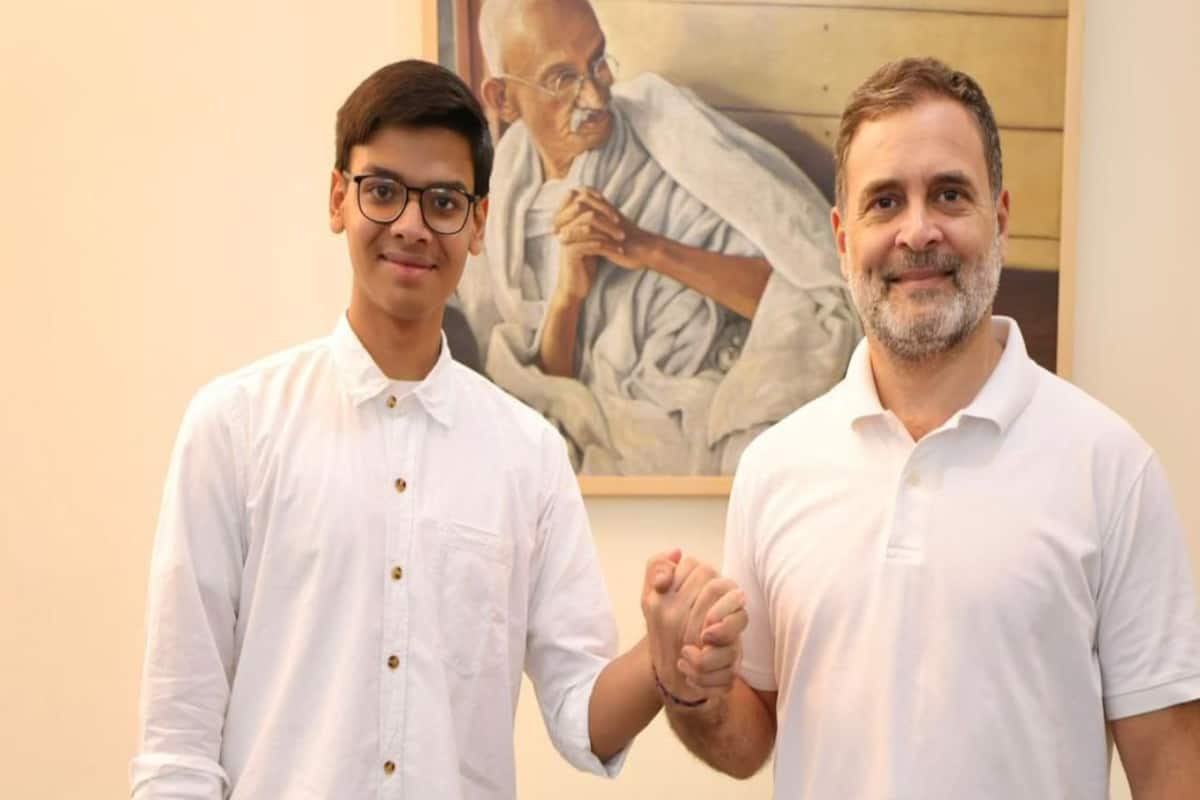
Sarthak Sidhant did a superb expose on CBSE’s shoddy handing on contract to Coempt (Photo: India.com)
Not just that, the CBSE even ignored the warnings of expert committee about Coempt’s software and went ahead with the exams. Nisargha Adhikary (19), a cybersecurity researcher even went on to expose the vulnerability in the whole Coempt platform. He showed how anyone with basic coding skills can hack into the platform, log in as an invigilator and check student’s copies.
Now, it doesn’t need any rocket science to connect the dots despite of so much evidence out in the open. There clearly seems a quid-pro-quo between Coempt and the government, otherwise nothing can explain handing tender to a firm with such a shoddy past. This whole mess has left the fate of 1.7 lakh students in jeopardy with re-evaluation and subsequent final results yet to be declared, leaving the students unable to secure admission in top universities and derailing the entire national college admission cycle.
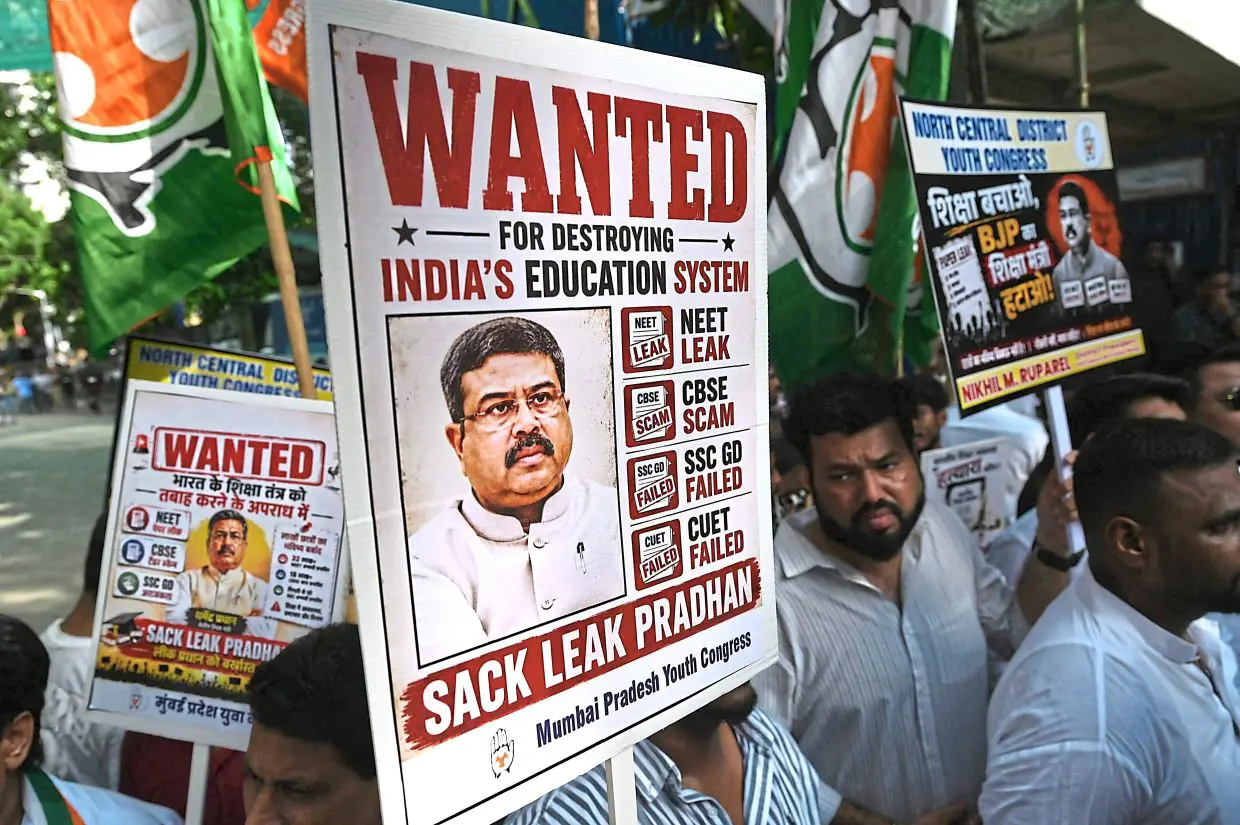
There has been massive outrage demanding Dharmendra Pradhan’s resignation (Photo: The Star)
The History of Paper Leaks
Cheating in examinations is not a new thing, it has been happening in different forms over the years. However, in today’s digital age, there has been a massive spike in paper leak. Since 2015 at least 150-180 paper leaks have already taken place affecting crores of students. In addition to NEET, critical exams like UGC-NET, SSC (one of country’s most heavily applied exam) and different state level exams have also seen instances of paper leak and other discrepancies. Additionally, massive delays (2-3 years) in result announcement and final joining have only made the situation worse for students from poor background who don’t have many options in private institutions.
As I pointed above, in the digital age, apps like WhatsApp and Telegram have become a strong tool used by the miscreants to leak the papers. Countering this needs modern solutions as well. Moving towards more and more computer-based tests, transferring questions through secure encrypted files and assigning a competent vendor – one with most capable database not the one putting cheapest tender – to handle the exams, are some needy steps. However, considering the snail pace of implementation and government’s immunity from accountability don’t give a very positive hope.

Situation of a government school in UP (Photo: India Today)
Is Education priority anymore?
India’s overall GDP allocation towards education has remained static around 2.8% over the years, with the outlay of Research & Development standing at meagre 0.6%, while the same number for advanced research-oriented countries stand at 3-4%. Amid a rapidly evolving world, the curriculum hasn’t been able to inculcate the impact of digitization and AI. Not many schools are able to provide the much-needed skill training to students that can open them up for different job markets, instead of solely relying on traditional jobs and government exams. And the less I talk about the saffronization of curriculum and educational institutions, the better.
The situation becomes even dire if we look at the condition of government schools. Between 2015 and 2026, over 90,000 government schools were closed with Uttar Pradesh and Madhya Pradesh topping the chart. While it is mandated to have 1 teacher for every 30 students, it’s hardly met anywhere. Gujarat, especially, is leading from the front here with over 12,000 schools being run by just 1 or 2 teachers. If this was not enough, there are over 60,000 schools in the country with less than 10 students but still having 1.4 lakh teachers in its name. I think you are smart enough to understand the ‘game’ being played here. The migration of students from government to private schools has spiked drastically, and understandably so. Having said that, keep in mind all these schools are run (in whatever way) by our taxpayer’s money, yet no government minister educates their children in India, leave alone government schools.
As I pointed right in the first para how important it is for a country to focus on education. Now, it’s a question we need to ask ourselves, has the emphasis on education, which used to be such a core thing in our society, remained the same over the last decade? Do we as a society and more importantly as an electorate give education the priority it deserves. How many people actually demand robust education system and timely examinations from the politicians? If your answer to these questions is NO, then why are we even expecting even a needle to move in the direction. See, the politicians are very smart. They know what fetches them votes and they work for that. So, if anti-Muslim hatred is doing the job, then what’s the need to even think of challenging (but important) areas of education and healthcare?

Visuals from CJP protest at Jantar Mantar (Photo: Al Jazeera)
The ‘Cockroach’ Protests
Amid the massive youth distress over paper leaks, squandering education system and high unemployment, a satirical youth movement named ‘Cockroach Janata Party’ (CJP) has emerged in limelight. From grabbing eyeballs with their humorous yet attractive manifesto to surpassing the followers of “world’s largest political party” BJP on Instagram, it has kept itself in news. They have followed it up with protests in the national capital (some other cities too) demanding the resignation of Education Minister Dharmendra Pradhan.
Now, it doesn’t matter which side of the political spectrum you are on, or what perception you have about the CJP. Even I have my apprehensions on the ideology of this new movement. But I can support anyone as long as the ‘issue’ they are raising is right and important, which is the case here. No one can deny that the government has badly failed on the front of education and the accountability has to be fixed. Now, many might say that Mr Pradhan’s resignation won’t fix the system. Maybe yes, but as I pointed earlier, it’s not just about NEET or CBSE, but the longstanding ignorance or rather neglect of India’s education system. It should be the responsibility of every citizen to demand its fixation, with or without this education minister.
Thank you For Your Attention To This Matter
JAI HIND